

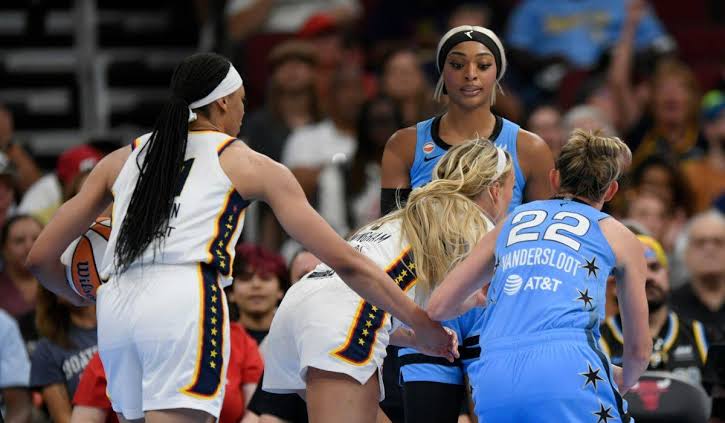
A routine drive to the basket suddenly turned into one of the most heated moments of the Indiana Fever’s matchup with the Chicago Sky. Sophie Cunningham was attacking the rim when Chicago forward DiJonai Carrington made forceful contact with Cunningham’s face, immediately bringing the play under intense scrutiny.
The officials didn’t hesitate. Carrington was assessed a Flagrant 2 foul and ejected from the game, ending her night after the physical confrontation with the Indiana guard. The decision instantly raised the biggest question surrounding the incident: did the officials make the correct call?
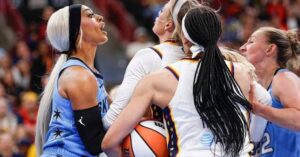
The play happened early in the contest as Cunningham drove toward the basket looking to finish at the rim. As she moved into the scoring area, Carrington made contact with both hands around Cunningham’s face, sending the Fever player into an awkward and dangerous position.
There was little room for debate about the outcome once the officials reviewed the severity of the contact. A Flagrant 2 carries the most serious in-game penalty short of a disqualification for other reasons, and Carrington was sent straight to the locker room.
For Indiana, the incident added another layer of intensity to an already physical game. Cunningham is known for playing with plenty of toughness, and the contact immediately became one of the most talked-about moments of the matchup.
It also put the spotlight directly on Carrington.
The Chicago forward has built a reputation as an aggressive defender, particularly when guarding players who attack the basket. But there’s a major difference between hard defensive contact and a play that officials determine crosses the line into dangerous territory.
That distinction mattered here.
Cunningham had committed to the drive, and Carrington’s hands made direct contact with her face. Whether the action was intentional or simply the result of a fast-moving defensive play, the officials determined that the contact was serious enough to warrant a Flagrant 2.
That meant Carrington’s game was over.
There was no opportunity for Chicago to keep its defensive specialist on the floor and no chance for Carrington to play a role in the remainder of the contest. The Sky had to adjust immediately after losing one of their key players to the ejection.
For Indiana, Cunningham was able to remain involved after taking the blow. That was particularly important because the Fever were already dealing with the physical nature of the game, with both teams battling for every possession.
And the timing couldn’t have been more dramatic.
The incident occurred during a matchup that already carried plenty of attention because of the Fever’s talented backcourt and the growing intensity surrounding Indiana’s games. With players competing at full speed, even a single defensive sequence can quickly change the tone of an entire night.
The question now is whether Carrington deserved the Flagrant 2.
Some observers will argue that the contact was excessive because Cunningham was struck in the face, making the play significantly more dangerous than an ordinary basketball foul. Others may believe Carrington was attempting to defend the drive and that the contact happened during a chaotic moment near the basket.
That’s exactly why the play will continue to generate discussion.
Officials are instructed to consider more than simply whether contact occurred. The location of the contact, the force involved and the potential danger to the opposing player all matter when determining whether a foul rises to the level of a Flagrant 2.
In this case, the referees decided the threshold had been crossed.
Carrington’s ejection also changed the tactical picture for Chicago. Losing a perimeter defender during a competitive game forces a team to redistribute defensive responsibilities, especially against an Indiana lineup capable of creating mismatches.
For Cunningham, the priority was simply continuing to play after the frightening collision.
The Fever guard drove toward the basket expecting a normal defensive challenge. Instead, the sequence ended with an ejection, a lengthy discussion among viewers and another reminder of just how quickly physical play can escalate in professional basketball.
Now comes the debate.
Did the officials get it right?
Was Carrington’s contact severe enough to justify a Flagrant 2 and immediate ejection, or should the officials have stopped at a less serious foul?
Whatever side fans take, one thing is certain: the decision changed the game and turned one drive to the basket into the defining controversy of the night.
