

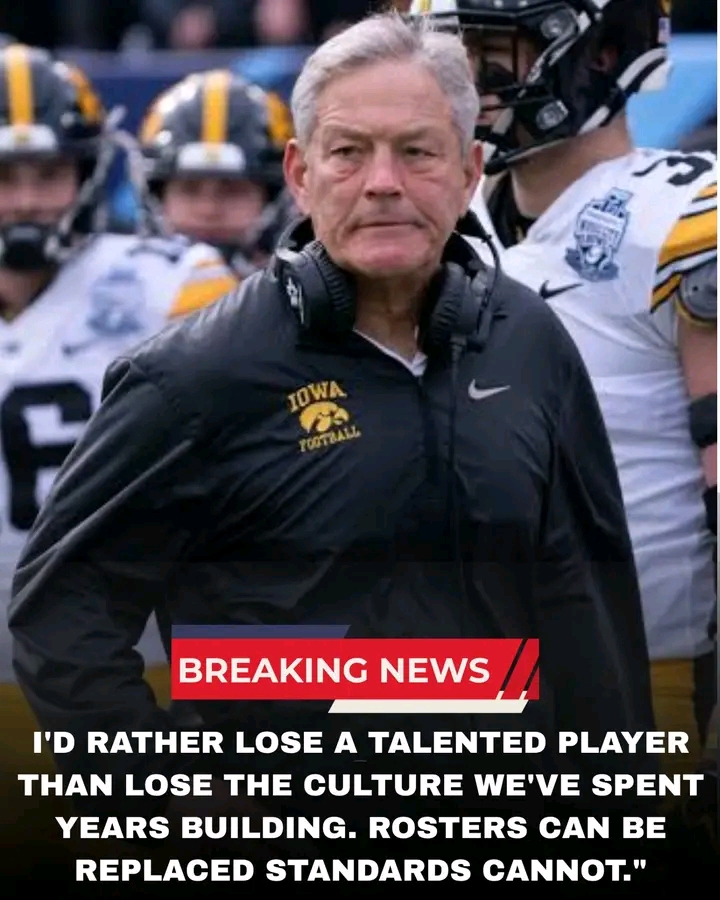
A claim circulating about Iowa football has sparked an important conversation about Kirk Ferentz’s standards, player freedom and the kind of culture the Hawkeyes want to maintain. But there’s a major detail supporters should know before believing the headline: there’s no verified evidence that freshman quarterback Tradon Bessinger has been dismissed from the program for questioning Ferentz’s coaching standards.
In fact, Iowa’s official 2026 football roster still lists Bessinger as a freshman quarterback wearing No. 4. The 6-foot-5, 213-pound Kaysville, Utah, native remains part of a quarterback room that also includes Jimmy Sullivan, Hank Brown, Jeremy Hecklinski and Ryan Fitzgerald.
That reality changes the story considerably, but it doesn’t make the larger discussion around Iowa’s culture any less interesting. Ferentz has spent decades building a program where discipline, preparation and accountability are treated as fundamental parts of wearing the black and gold.
Bessinger, meanwhile, arrived in Iowa City with plenty of expectations attached to his name. The former Davis High School quarterback was one of the most accomplished players in Utah’s 2025 high school class, earning Utah Player of the Year honors after throwing for more than 4,300 yards and 53 touchdowns as a senior.
His high school résumé explains why Iowa supporters are paying attention to his development. Over three seasons as a starter, Bessinger accumulated 10,908 passing yards and 127 touchdowns, while completing 76 percent of his passes during his senior campaign. He also broke Utah’s state record for completions in a season with 333.
So, if a young quarterback with that kind of background ever did challenge aspects of a coaching program, it would raise a legitimate question: how does a traditional college football program balance player expression with its established standards?
That question is becoming increasingly relevant across the sport.
College football players have more opportunities than ever to speak publicly, build personal brands and express opinions about their teams. Coaches, meanwhile, still have to maintain order inside a locker room containing athletes with different personalities, expectations and ambitions.
Iowa has long leaned toward structure.
Ferentz’s program has traditionally emphasized development over instant gratification. Players aren’t simply expected to arrive and demand immediate playing time. They’re asked to learn the system, compete for opportunities and prove themselves within the team’s framework.
That approach has helped define Iowa football for years.
It also explains why the idea of a player being removed simply for questioning coaching standards would attract so much attention. Such a decision would represent a significant statement about where the program draws the line between constructive criticism and behavior that undermines team discipline.
But in Bessinger’s case, the available evidence doesn’t support that storyline.
Instead, the freshman quarterback is currently listed on Iowa’s roster as he begins his college career. His immediate challenge is much more straightforward: learn the offense, compete inside a crowded quarterback room and earn the trust of the coaching staff.
That alone will be worth watching.
Bessinger isn’t being asked to reproduce his Davis High School numbers overnight. College football is a different level, and Iowa has several quarterbacks competing for opportunities.
For now, the real story isn’t a supposed firing.
It’s whether one of Iowa’s most intriguing young quarterbacks can develop inside one of college football’s most established programs — and eventually become the player many expected when he signed with the Hawkeyes.
The culture debate will continue, but the facts matter.
And right now, Tradon Bessinger remains an Iowa Hawkeye.
