

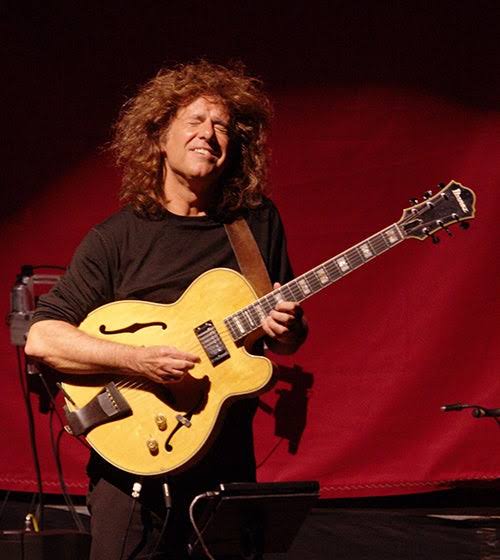
There are guitarists who master an instrument, and then there are musicians who make the instrument sound as if it has discovered an entirely new language. Pat Metheny belongs firmly in the second category. As the celebrated American guitarist and composer turns 72, his remarkable journey stands as a reminder of just how far imagination can take a musician.
Born in Lee’s Summit, Missouri, on August 12, 1954, Metheny began building his musical identity in the 1970s. From 1976 onward, he steadily developed a reputation for connecting musical worlds that might not have seemed like natural partners, blending jazz, fusion, Brazilian influences and other styles into something unmistakably his own.
What made Metheny particularly fascinating wasn’t simply the number of genres he explored. It was the way he connected them. Rather than treating musical styles as separate boxes, he used composition and guitar playing to move between them, creating music that could feel sophisticated and technically demanding while remaining remarkably accessible.
The Pat Metheny Group Changed the Conversation
A major part of that story came through the Pat Metheny Group, his long-running collaboration with keyboardist Lyle Mays. Together, Metheny and Mays developed a distinctive fusion sound that avoided simply following the funk-heavy direction associated with much of the genre at the time.
Instead, their music often breathed.
There was space in it, movement and atmosphere. Brazilian musical colors became an important part of the group’s identity, while Metheny’s compositions brought together jazz harmony, memorable melodies and an almost cinematic sense of progression.

That’s one reason the Pat Metheny Group’s music can feel like a soundtrack to an unfolding journey. You don’t simply hear individual notes and rhythms; you can almost picture landscapes passing outside a car window, with one musical idea naturally leading into another.
A Guitarist Who Could Do Almost Anything
Metheny’s reputation, however, wasn’t built solely on the Pat Metheny Group. His work as a guitarist established him as one of the most distinctive voices of his generation, particularly because he could move between two seemingly opposite approaches without losing his identity.
On one side, there’s the technically dazzling Metheny.
His playing can become incredibly fast and intricate, filled with chromatic passages that demand extraordinary control and precision. Those moments showcase the guitarist’s ability to navigate complicated musical ideas at remarkable speed.
Then there’s another Metheny.
He can slow everything down and allow a melody to breathe, producing lines that sound lyrical, warm and almost vocal. That contrast became one of his greatest strengths: the same musician capable of astonishing technical passages could also deliver a simple melodic phrase with extraordinary emotional weight.
From Fusion Innovator to Jazz Heavyweight
Metheny’s influence became even clearer as his career expanded beyond the sound that first made him famous. While the Pat Metheny Group earned him widespread recognition and inspired countless musicians, his more explicitly jazz-oriented recordings revealed another side of his artistic ambitions.
In those settings, his playing could become tighter and more intense. Elsewhere, he returned to the spacious, lyrical approach that had become one of his trademarks.
That versatility helped Metheny avoid being confined to a single musical label. He wasn’t simply a fusion guitarist, nor was he only a traditional jazz player. His career repeatedly challenged listeners to reconsider where one style ended and another began.
Why Pat Metheny’s Influence Still Matters
Perhaps the most impressive part of Metheny’s story is that his innovation never required him to abandon melody. Technical complexity was there when he wanted it, but it was rarely complexity for its own sake.
That’s an important distinction.
A guitarist can play faster than almost anyone else and still leave listeners cold. Metheny’s most memorable work demonstrates something different: virtuosity becomes far more powerful when it serves a musical idea.
His approach also helped show younger guitarists that jazz could absorb influences from outside its traditional boundaries without losing its identity. Brazilian sounds, modern fusion, atmospheric textures and sophisticated jazz language could coexist within the same musical world.
Celebrating a Career Built on Curiosity
At 72, Pat Metheny’s legacy isn’t simply measured by the number of records he has released or the musicians he has influenced. It’s found in the freedom of his musical thinking.
From his breakthrough years beginning in the mid-1970s to his work with Lyle Mays and the Pat Metheny Group, and through his more jazz-focused solo projects, Metheny has consistently treated music as something to explore rather than something to contain.
That’s why his birthday feels like more than an occasion to celebrate a famous guitarist. It’s a chance to recognize an artist who spent decades asking how many different sounds could belong together and then proving that the answer was far bigger than anyone expected.
