

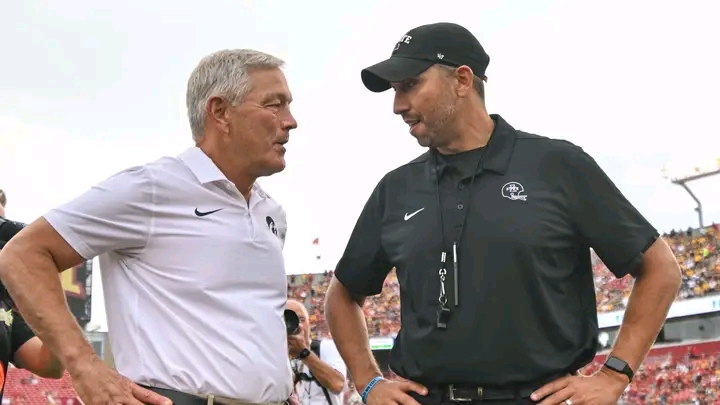
Few people understand the demands of Big Ten football better than Iowa head coach Kirk Ferentz, and when he was asked about Matt Campbell’s transition to Penn State, his response carried plenty of weight. Ferentz has spent years competing against elite programs, and his assessment suggested Campbell has the qualities needed to thrive in one of college football’s most demanding jobs.
Campbell officially took over as Penn State’s head coach after a highly successful decade at Iowa State, where he transformed the Cyclones from a struggling Big 12 program into a consistent contender. During his tenure in Ames, Campbell compiled a 107-70 overall record, captured two Big 12 regular-season championships, and became one of the nation’s most respected program builders.
Ferentz’s perspective is particularly noteworthy because he watched Campbell’s rise from nearby for years. Rather than focusing only on wins and losses, Iowa’s veteran coach pointed to Campbell’s leadership, player development, and ability to establish a strong culture qualities that many believe translate regardless of conference or expectations. Those traits helped Campbell become one of the hottest coaching names in college football long before Penn State finally secured his signature.
The move also marks a dramatic shift in the Big Ten landscape. Instead of building Iowa State into a contender in the Big 12, Campbell now inherits one of the nation’s premier football brands with significantly greater recruiting resources, stronger NIL backing, and championship expectations every season. Reports indicate Penn State is investing heavily in football, giving Campbell resources he rarely enjoyed during his Iowa State tenure.
That combination of experience and opportunity is exactly why Ferentz believes Campbell fits naturally in Happy Valley.
Throughout his coaching career, Ferentz has emphasized discipline, accountability, and consistency. Those same characteristics have defined Campbell’s reputation. At Iowa State, Campbell routinely developed overlooked recruits into NFL-caliber players while guiding the Cyclones to some of the biggest victories in school history.

Instead of relying solely on recruiting rankings, Campbell built competitive teams through development and culture. That philosophy helped Iowa State defeat several nationally ranked opponents and remain competitive despite operating with fewer financial advantages than many conference rivals.
Now, Penn State presents an entirely different challenge.
Unlike Iowa State, where simply competing for conference championships represented historic success, Penn State measures seasons by College Football Playoff appearances and national championship contention. Every recruiting cycle, every transfer portal decision, and every Saturday carries national attention.
Campbell appears to understand those expectations.
During his introductory press conference, he emphasized integrity, leadership, grit, and building relationships before discussing wins. He also praised Penn State’s tradition while insisting financial advantages alone would not define the program’s future success. Instead, Campbell stressed developing players, creating accountability, and preserving the culture that has long made Penn State one of college football’s flagship programs.
That philosophy closely mirrors what Ferentz has built over more than two decades at Iowa.
Even as fierce conference competitors, successful coaches often recognize excellence in one another. Ferentz’s comments reflected that professional respect rather than rivalry. Building a sustainable winner requires far more than play-calling—it demands leadership through adversity, trust inside the locker room, and consistency throughout the organization.
Those are areas where Campbell has repeatedly earned praise.
His recruiting approach also remains relationship-driven. Campbell has explained that finding players who genuinely fit the program matters more than simply chasing recruiting stars. That strategy proved successful at Iowa State and now has the potential to become even more dangerous with Penn State’s expanded recruiting reach and financial support.
The transition, however, won’t be easy.
Penn State fans expect immediate results, especially in a Big Ten that now features perennial powers such as Ohio State, Michigan, Oregon, USC, Washington, and Iowa battling every season. Campbell inherits both opportunity and pressure unlike anything he experienced previously.
Still, many analysts believe Penn State found exactly the type of coach it needed. National observers have described Campbell as an ideal cultural fit whose proven ability to build programs may be even more valuable than splashy headlines.
Ferentz’s endorsement only strengthens that belief.
When one of college football’s longest-tenured and most respected coaches says another coach possesses the right qualities for a prestigious job, people across the sport pay attention. Ferentz understands the weekly grind of competing in the Big Ten, and his confidence in Campbell suggests Penn State may have found more than just a replacement it may have found its next long-term leader.
Whether Campbell can translate that promise into conference championships and College Football Playoff success remains the biggest question entering the new season. But if Ferentz’s evaluation proves accurate, Penn State’s coaching change could ultimately reshape the balance of power in the Big Ten for years to come.
