


Kate Martin may have left Golden State, but the former Valkyries guard clearly hasn’t left the thoughts of her old coach. Natalie Nakase’s comments about Martin offered an intriguing reminder of what the Los Angeles Sparks gained when they brought the Iowa product into their organization.
Martin’s move to Los Angeles came after the Golden State Valkyries waived her in May. The Sparks initially signed her to a player-development contract, giving the 6-foot guard another opportunity to establish herself in the WNBA after spending her first two professional seasons with the Valkyries.

What makes Nakase’s comments particularly interesting is that they weren’t centered on scoring numbers or statistics. Instead, the Golden State coach pointed to the qualities that can be harder to measure: Martin’s energy, personality and willingness to compete. Nakase said the Valkyries missed Martin’s “energy,” “comedy” and “ruthlessness,” a description that says plenty about the role Martin played away from the box score.
That kind of impact can be easy to overlook in professional basketball. A player doesn’t have to lead a team in points or rebounds to influence a locker room, and Martin appears to have built a reputation for doing exactly that.
For Los Angeles, the timing couldn’t have been much more interesting. The Sparks weren’t simply adding another player to their backcourt; they were bringing in someone who already understood the demands of the WNBA and had experience playing under Nakase in Golden State.
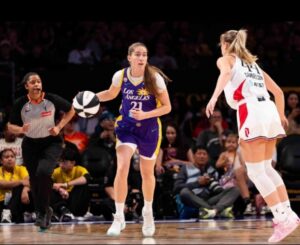
Martin’s arrival also represented another chapter in a career that has already taken several unexpected turns. After starring at Iowa and reaching consecutive national championship games with the Hawkeyes, she entered the professional ranks and quickly became a recognizable part of the Valkyries’ early identity. Her transition to Los Angeles gave her a chance to reset and carve out another role.
And the Sparks didn’t appear to view her as merely a temporary addition. On July 6, Los Angeles converted Martin’s development contract into a standard WNBA contract, officially moving her onto the team’s regular roster.
The numbers haven’t suggested that Martin is being asked to carry the offense. Through 15 appearances for Los Angeles, she had played 104 minutes and averaged 2.4 points, 0.9 rebounds and 0.3 assists per game. She had also made seven of her 24 three-point attempts.
Those figures tell only part of the story, though. Martin’s value to the Sparks can also come from the less glamorous parts of the game — communicating, competing for loose balls, spacing the floor and bringing a steady presence when she’s on the court.
Nakase’s words give that bigger picture some credibility. Coaches spend countless hours around players that fans rarely see, from practices and film sessions to locker-room conversations. When a coach specifically remembers a player’s personality and competitive edge, it’s usually an indication that the player’s influence extended beyond what appeared on the scoreboard.
There was also something symbolic about Martin’s return to Golden State in June. When the Sparks visited the Valkyries at Chase Center, Martin was back in the building where she had spent the previous season. The Valkyries themselves acknowledged the familiarity surrounding the matchup, highlighting Martin as one of the former players returning to face Golden State.
For Martin, that transition could ultimately prove valuable. She now has an opportunity to establish herself in a different environment while bringing lessons from her time with the Valkyries to a Sparks team looking to build something of its own.
And perhaps that’s the most interesting part of Nakase’s praise. It wasn’t simply nostalgia from a coach missing a former player. It was recognition of something Martin brings wherever she plays: energy, personality and a competitive edge that teammates notice even when the statistics don’t jump off the page.
Los Angeles will ultimately judge Martin by what she contributes on the court. But if Nakase’s assessment is any indication, the Sparks may already be benefiting from something that doesn’t appear in the box score the kind of presence that can quietly change the feel of a locker room.
