

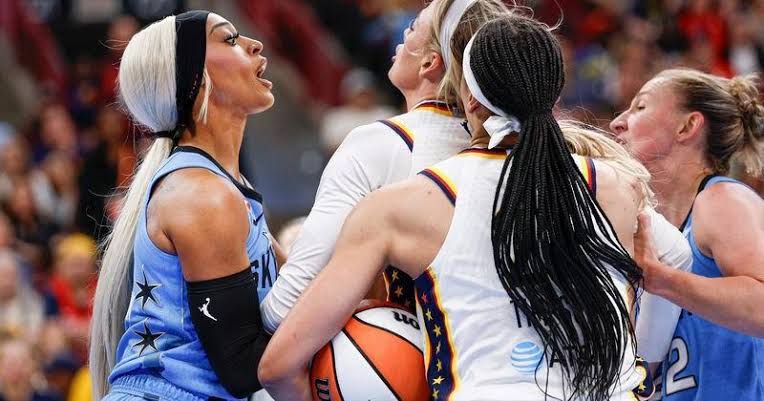
A hard foul involving Indiana Fever guard Sophie Cunningham has now spilled beyond the basketball court, with Florida Attorney General James Uthmeier issuing a striking warning aimed at the WNBA. What began as a heated moment during a game between the Fever and Chicago Sky has quickly become part of a much larger conversation about player safety, officiating and the growing intensity surrounding the league.
Uthmeier, Florida’s attorney general, was quoted as saying the WNBA should think twice about bringing games to the state if players are going to cross the line into conduct he believes could amount to assault. His comments came after Chicago Sky player DiJonai Carrington was ejected following a Flagrant 2 foul involving Cunningham.
The incident immediately became one of the most talked-about moments surrounding the game. Carrington was handed the Flagrant 2 and removed from the contest, while Cunningham became the central figure in a debate that quickly moved beyond the final score.
Uthmeier’s warning
The Florida attorney general didn’t mince his words when addressing the controversy.
“The WNBA knows better than to play games down here in Florida, because I’ll be charging people with assault,” Uthmeier said, according to the statement circulating online.
The comment represents a remarkable escalation in the discussion. Rather than treating the incident solely as a basketball disciplinary matter, Uthmeier framed the issue through the lens of potential criminal conduct, making his intervention particularly notable.
For a professional sports league that regularly deals with physical contact, hard fouls and heated exchanges, the distinction between an aggressive basketball play and conduct that could warrant legal consequences is a serious one.
Carrington ejected after foul
Carrington’s night came to an early end after officials determined that her contact with Cunningham warranted the game’s most severe disqualification-level foul.
A Flagrant 2 is not simply another personal foul. Under basketball rules, it is generally reserved for contact officials consider unnecessary and excessive, and it results in an automatic ejection.
That decision placed Carrington under an intense spotlight. The incident was replayed and discussed extensively, with viewers examining the contact from different angles and debating whether the punishment matched what happened on the court.
The controversy didn’t stop once Carrington left the game, either.
Carrington responds with “White privilege” accusation
Following the incident, Carrington also made a separate accusation involving Cunningham and the Fever.
Carrington claimed that Cunningham and the Indiana Fever benefited from what she described as “White privilege,” adding another dimension to an already contentious situation.
Her comments shifted the conversation from the foul itself to broader issues surrounding race, media attention and how players are treated within women’s basketball.
That distinction matters because the disagreement is no longer simply about whether a foul was excessive. It has become part of a broader argument about fairness and perceptions of treatment in the WNBA.
Why this controversy is bigger than one foul
The WNBA has experienced enormous growth in attention, particularly as high-profile players have attracted larger television audiences and increasingly intense social-media discussion. With that visibility comes greater scrutiny every time a controversial incident occurs.
Cunningham, Carrington and the Indiana Fever have all found themselves at the center of that attention following the confrontation.
For league officials, the challenge is finding the balance between allowing the physical competitiveness that makes professional basketball compelling and ensuring players aren’t subjected to dangerous or unacceptable contact.
That’s particularly important when controversial plays become viral moments within minutes. A single foul can quickly turn into thousands of posts, heated arguments and accusations involving players, teams and even public officials.
The next question for the WNBA
Uthmeier’s comments add another layer to the controversy because they came from a state official rather than a player, coach or league representative.
Whether his warning leads to any further action remains to be seen. For now, the Flagrant 2 issued to Carrington remains the official basketball consequence of the incident, while the public debate surrounding the play continues.
The controversy also highlights just how much attention the WNBA is receiving. Moments that might once have remained inside a basketball arena are now being discussed by athletes, fans, commentators and government officials.
And with Uthmeier openly invoking the possibility of assault charges, the conversation surrounding Cunningham and Carrington has clearly moved well beyond the hardwood.
