

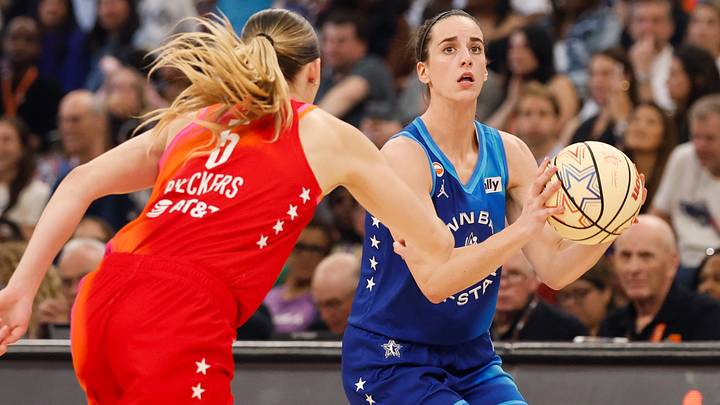
Caitlin Clark has spent much of the 2026 WNBA season making headlines, but not all of them have been about basketball. As the Indiana Fever superstar continues carrying the weight of being the league’s biggest attraction, she recently received an encouraging message from one of the most recognizable figures in American history former President Barack Obama.
The heartfelt exchange quickly became one of the biggest stories surrounding WNBA All-Star Weekend in Chicago. At a time when Clark has found herself at the center of constant debates, criticism, and on-court controversy, Obama’s words offered a reminder that sometimes the most valuable support comes from the most unexpected places.
The timing couldn’t have been more significant. Clark had just wrapped up another impressive All-Star appearance at the United Center, helping Team Spoon defeat Team Coop 129-122 in one of the highest-scoring games of the weekend. While the game showcased the league’s brightest stars, much of the conversation afterward shifted away from basketball and toward the personal encouragement Clark received from the former president.
Clark once again proved why she remains one of the WNBA’s premier talents. Starting alongside Indiana Fever teammate Aliyah Boston for Team Spoon, the former Iowa Hawkeyes sensation finished with 17 points, four rebounds, and five assists. On the opposite side, Fever teammate Kelsey Mitchell delivered an outstanding performance of her own, leading all scorers with 28 points for Team Coop despite ending up on the losing side.
Although the All-Star Game celebrated the league’s elite players, Clark’s off-court moment quickly became the headline that captured national attention.
A video shared by Yahoo Sports showed former President Barack Obama personally speaking with Clark and offering advice that resonated far beyond basketball.
His message was simple but meaningful.
“Don’t let all this nonsense get you down… don’t lose that joy.”
Those few words carried significant weight considering everything Clark has experienced throughout the season.
For months, the Fever guard has found herself at the center of nearly every major WNBA storyline. While her performances have continued to attract record television audiences and sold-out arenas, the surrounding controversies have often overshadowed what she has accomplished on the court.
One of the biggest flashpoints came during Indiana’s matchup against the Phoenix Mercury when veteran star Alyssa Thomas placed her fist against Clark’s throat during a heated moment. The incident immediately dominated sports headlines and sparked weeks of debate about officiating, physical play, player safety, and the treatment of the league’s biggest star.
Instead of discussions focusing on Indiana’s basketball or Clark’s production, much of the national conversation revolved around that single confrontation.
Eventually, Clark decided to address the situation publicly.
She acknowledged that while she believed officiating deserved scrutiny, she also wanted people to remember there was a real person behind the headlines.
Clark urged everyone to move beyond the constant negativity surrounding both herself and the WNBA, reminding people that she has feelings just like every other athlete. Rather than fueling more controversy, she encouraged the focus to return to basketball.
That perspective makes Obama’s message especially meaningful.
As someone who spent eight years serving as President of the United States, Obama understands what it feels like to live under relentless public attention. Every decision, every comment, and every public appearance during his presidency generated discussion from supporters and critics alike.
His advice wasn’t about basketball strategy or handling media interviews.
Instead, it centered on protecting something much more important—Clark’s love for the game.
The reminder to “don’t lose that joy” reflects a lesson many elite athletes eventually learn. External pressure, criticism, and constant public scrutiny can slowly replace the passion that first inspired them to compete.
For Clark, basketball has always been played with visible emotion, confidence, and creativity. Those qualities helped transform her into the NCAA’s all-time leading scorer, elevated Iowa women’s basketball to unprecedented popularity, and eventually helped reshape the WNBA’s national profile.
Maintaining that same joy while becoming one of the world’s most recognizable athletes is now one of her biggest challenges.
Obama isn’t the only prominent public figure to publicly support Clark during this demanding stretch.
Former United States women’s soccer star Alex Morgan has also praised Clark for everything she has accomplished at such a young age. Morgan applauded Clark’s ability to handle extraordinary expectations while continuing to inspire young athletes across the country.
Support from respected figures outside basketball illustrates just how much Clark’s influence has expanded beyond the sport itself.
At only 24 years old, Clark has become one of the most recognizable athletes in the world.
Every game she plays generates enormous television ratings. Road arenas continue selling out whenever Indiana visits. Her highlights dominate social media, while every postgame interview is analyzed by fans and national media alike.
With that level of visibility comes relentless scrutiny.
Every hard foul becomes a national debate.
Every disagreement with officials sparks online arguments.
Every emotional reaction receives widespread attention.
Few athletes in professional sports face that level of daily examination.
Despite the distractions, Clark continues producing on the floor while helping lead the Indiana Fever through another competitive season.
During the All-Star Game alone, she contributed across every major statistical category with 17 points, four rebounds, and five assists, while Boston added another strong performance and Mitchell poured in a game-high 28 points.
The exhibition also highlighted the chemistry that has helped make Indiana one of the league’s most exciting teams to watch.
Yet even after another productive night, the conversation once again extended beyond basketball.
That reality reflects Clark’s unique place within today’s sports landscape.
She is no longer simply a WNBA star or a former Iowa legend.
She has become one of the faces of women’s sports globally, carrying expectations that few athletes her age have ever experienced.
Moments like her conversation with Barack Obama serve as an important reminder that even the biggest stars sometimes need encouragement.
Athletes may perform before millions of viewers, but they still experience pressure, frustration, and emotional exhaustion like anyone else.
Clark has repeatedly demonstrated remarkable resilience throughout her basketball career, from breaking scoring records at Iowa to embracing the enormous expectations that followed her into the WNBA.
Now she faces perhaps her greatest challenge not proving she belongs among the league’s elite, but learning how to thrive while living under a spotlight that rarely turns away.
If Obama’s advice accomplishes anything, it may simply remind Clark to hold onto the excitement and confidence that made basketball fun long before she became a household name.
As the Fever begin the second half of the season, Clark’s focus will undoubtedly return to winning games and chasing playoff success.
But after months of criticism, controversy, and nonstop headlines, the former president’s message may ultimately become one of the most memorable moments of her 2026 season.
Sometimes the most powerful advice isn’t about scoring more points or winning more games.
Sometimes it’s simply remembering why you fell in love with the game in the first place and never allowing the noise surrounding it to take that away.
