

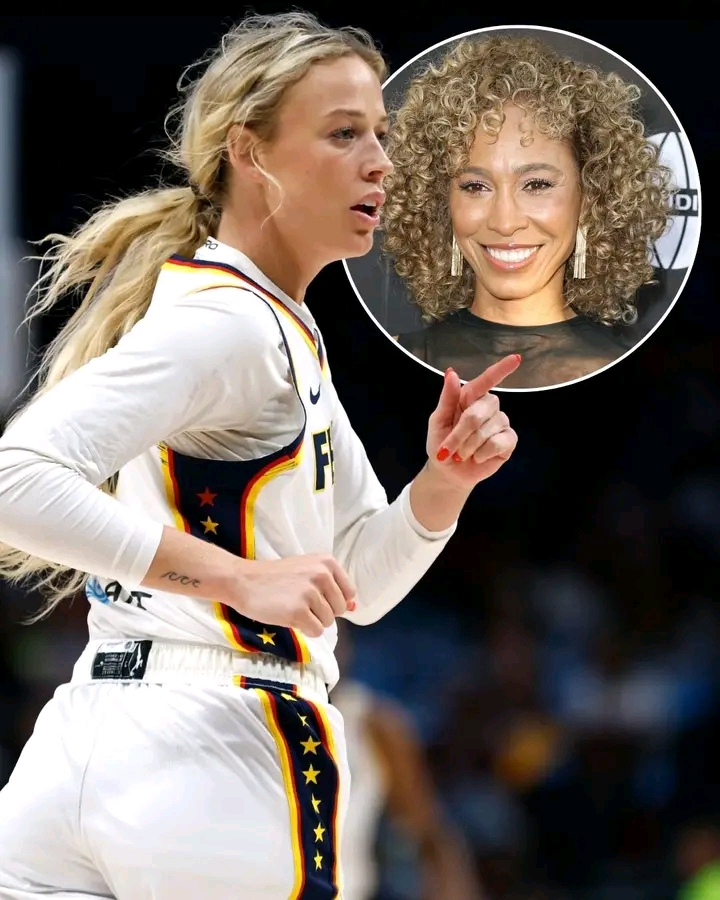
Sophie Cunningham’s outspoken comments on protecting women’s sports have found another high-profile supporter. This time, it was former ESPN broadcaster Sage Steele, who praised the Indiana Fever guard for taking a public stand on one of the most polarizing issues in modern athletics and argued that more female athletes should have the courage to speak openly.
Steele’s remarks come just days after Cunningham reaffirmed her position that biological males should not compete in women’s sports. The Fever veteran made those comments during an ESPN interview before doubling down with a firm response after Indiana’s 123-88 victory over the Connecticut Sun, telling reporters, “I said what I said.”
Rather than backing away from the criticism that followed, Cunningham insisted her views are motivated by fairness and safety, not hostility toward transgender people. She said she wants “to extend love,” while also protecting “young girls in a locker room” and ensuring female athletes are not required to compete against biological males.
Steele believes that message deserves broader support from within women’s sports. Speaking publicly about Cunningham’s stance, the former ESPN anchor applauded the Fever guard for using her platform and suggested that many other female athletes privately share similar concerns but are reluctant to say so publicly because of potential backlash.
The comments have once again placed Cunningham at the center of a debate that has stretched far beyond basketball. Since joining the Indiana Fever, the veteran guard has become known not only for her energetic play and leadership alongside Caitlin Clark but also for speaking candidly on issues she believes affect women’s athletics.
In her ESPN interview, Cunningham addressed accusations that she harbors anti-transgender views. She rejected that characterization, explaining that her position is based on honesty and protecting opportunities created through Title IX rather than excluding anyone from society.
“I got a lot of negative feedback about me hating trans,” Cunningham said. “I never once said that.” She added that she believes there is room to love everyone while still advocating for what she sees as fair competition in women’s sports.
Her comments quickly spread across social media, where supporters praised her willingness to address a controversial subject while critics argued that her remarks marginalized transgender athletes. The discussion has become one of the biggest off-court stories surrounding the WNBA this season.
Steele is hardly the first prominent voice to rally behind Cunningham. Former NCAA swimmer Riley Gaines described the Fever guard as one of the few current professional female athletes willing to risk criticism by speaking publicly, while political figures including Sen. Darline Graham and White House Press Secretary Karoline Leavitt have also defended Cunningham’s position.
At the same time, Cunningham has repeatedly emphasized that she does not consider herself a political activist. The 29-year-old has described her political views as being “very much in the middle,” saying she agrees with some positions from both sides while believing athletes should be free to express their personal convictions.
The timing of the controversy has added even more attention to the discussion. Cunningham’s comments came shortly after the U.S. Supreme Court allowed state laws in Idaho and West Virginia restricting transgender girls from competing in girls’ school sports to remain in effect, intensifying a nationwide conversation about fairness, inclusion, and the future of women’s athletics.
On the court, Cunningham continues to play an important role for the Fever during the 2026 WNBA season. She is averaging about 9.3 points per game while providing veteran experience to an Indiana team that has remained one of the league’s biggest attractions.
Whether people agree with her or disagree strongly, Cunningham has become one of the WNBA’s most talked-about figures. With respected media personalities like Sage Steele encouraging more female athletes to speak openly, the conversation surrounding women’s sports shows little sign of fading anytime soon.
For Cunningham, the message has remained remarkably consistent throughout the controversy. She says her goal is not to divide people but to defend what she believes is fair competition for girls and women. As support and criticism continue to pour in from across the sports and political worlds, her willingness to stand by her words has ensured that the debate remains firmly in the national spotlight.
