

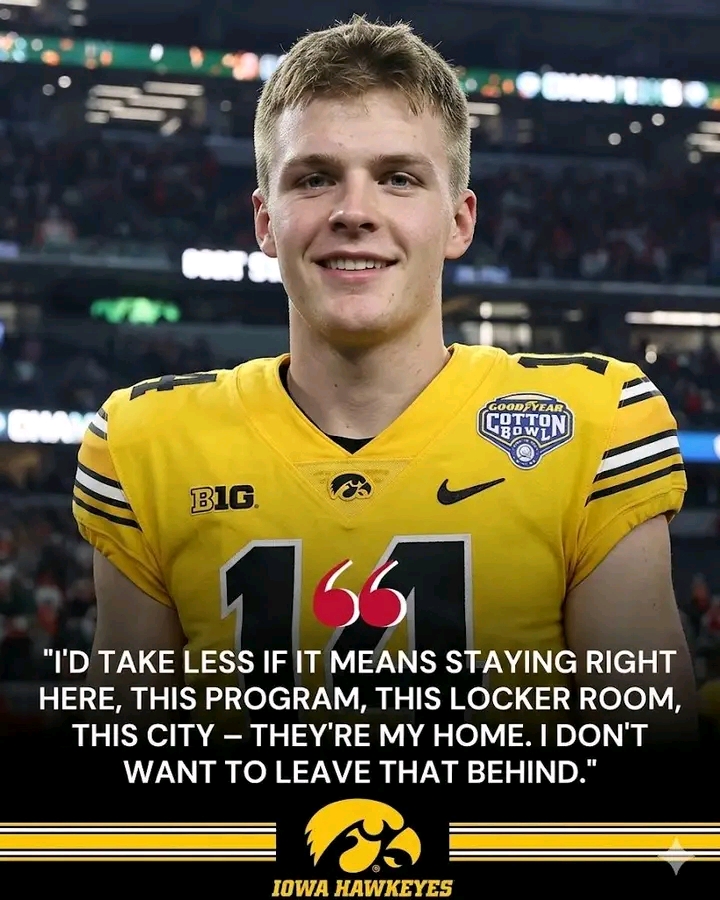
He Turned Down Millions: The Decision That’s Shaking College Basketball and Redefining Loyalty at Iowa
In an era where the transfer portal has become college basketball’s version of free agency, where NIL deals can reshape careers overnight, and where loyalty is often treated like a negotiable clause—one player just flipped the script.
Bennett Stirtz didn’t just make a decision. He made a statement.
And across the landscape of college basketball, people are still trying to process it.
The Offer That Changed Everything
The reality of modern college athletics is simple: if you’re talented, the market will find you.
And Stirtz? He wasn’t just talented he was in demand.
Programs across the country, many desperate for a proven playmaker, reportedly lined up with aggressive offers. Not just promises of playing time. Not just bigger roles. We’re talking about serious financial packages life-changing money tied to NIL opportunities, endorsement deals, and guaranteed exposure.
For a college athlete, it was the kind of situation that usually ends one way: a transfer announcement, a new jersey, and a fresh start somewhere else.
But this time, the story didn’t follow the script.
“This Is My Home”
When the noise reached its peakbagents calling, offers stacking, expectations buildingbStirtz gave an answer that was as simple as it was powerful:
“This is my home.”
That was it. No drawn-out statement. No dramatic reveal.
Just a decision rooted in something that’s becoming increasingly rare in modern sports: connection.
Choosing Brotherhood Over Business
Let’s be honest walking away from money in today’s college basketball environment isn’t just unusual. It’s almost unthinkable.
Players transfer for less. Programs rebuild overnight through the portal. Coaches adjust rosters like puzzle pieces.
But Stirtz looked at everything being offered the money, the guaranteed spotlight, the opportunity to elevate his individual brand and decided it wasn’t worth what he’d be leaving behind.
He chose teammates over transactions.
He chose continuity over chaos.
He chose identity over opportunity.
And in doing so, he reminded everyone that not every decision in sports is driven by dollars.
Inside the Locker Room: Why It Mattered
For the Iowa Hawkeyes, this wasn’t just about keeping a talented guard. It was about preserving something deeper.
Culture.
Programs talk about it all the time. Few actually get to prove it matters.
But when a player turns down significant financial incentives to stay, it sends a message that resonates far beyond one season.
It tells the locker room that what they’re building is real.
It tells younger players that loyalty isn’t outdatedbit’s valuable.
And it tells fans that their connection to the team still means something.
Because let’s face it: in a system increasingly driven by movement, stability is power.
The System vs. The Individual
College basketball today operates in a space where movement is expected. The transfer portal has made it easier than ever to leave. NIL has made it more lucrative than ever to do so.
For many players, it’s a smart decision.
Better exposure. Better pay. Better opportunities.
No judgment there.
But what Stirtz did challenges the idea that this is the only path.
He didn’t reject the system entirely. He simply refused to let it define him.
And that’s what makes this story different.
The Pressure Was Real
Make no mistake this wasn’t an easy call.
Sources close to the situation indicated that the offers weren’t symbolic. They were substantial. The kind of deals that could set a player up financially long before their professional career even begins.
Programs in need of a reliable playmaker weren’t just interested they were aggressive.
They were willing to guarantee roles. Build systems around him. Put the ball in his hands and let him run the show.
For most players, that’s a dream scenario.
For Stirtz, it wasn’t enough.
A Rare Kind of Loyalty
There’s a reason this story is gaining attention.
Because it feels… out of place.
In today’s sports world, loyalty is often seen as optional. Something you keep until a better offer comes along.
But Stirtz’s decision flips that idea.
It suggests that loyalty still exists not as a weakness, but as a strength.
Not as a limitation, but as a choice.
And maybe that’s why it resonates so deeply.
More Than Just Basketball
What makes this moment powerful isn’t just the decision itself it’s what it represents.
For some athletes, college isn’t just a stepping stone. It’s an experience. A community. A place where relationships matter just as much as results.
Stirtz’s choice reflects that mindset.
It’s about more than contracts and endorsements. It’s about identity. Belonging. Purpose.
Those aren’t things you can easily put a price on.
The Ripple Effect
Decisions like this don’t happen in isolation.
They send waves through the sport.
Teammates take notice. Recruits pay attention. Coaches use it as proof that culture still wins.
Even fans often skeptical in an era of constant roster changes find something to believe in again.
Because when a player chooses to stay, it creates something rare:
Continuity.
And in college basketball, continuity can be the difference between a good team and a great one.
Fans in Iowa City Have Their Answer
Inside Carver-Hawkeye Arena, the reaction wasn’t complicated.
It wasn’t about contracts or strategy.
It was about appreciation.
Because in a world where players come and go, Stirtz chose to stay.
And that means something.
It means the jersey still carries weight.
It means the connection between player and program still exists.
And it means that, at least for now, loyalty is alive and wearing black and gold.
A Quiet Rebellion
You won’t find dramatic headlines about rebellion or revolution in Stirtz’s words.
But make no mistake this was a form of resistance.
Not loud. Not confrontational.
Just… different.
In a system that rewards movement, he stayed.
In a culture that prioritizes money, he chose meaning.
And in doing so, he reminded everyone that the system doesn’t control every decision.
What Comes Next?
Now comes the real question: what does this mean moving forward?
For Iowa, it means stability. Leadership. A player who isn’t just committed on paper, but in mindset.
For Stirtz, it means responsibility. Expectations will rise. Attention will follow.
Because when you turn down what he turned down, people expect something in return.
Performance. Impact. Results.
And that’s fair.
But regardless of what happens on the court, the decision itself has already made an impact.
The Bigger Picture
Every so often, a story emerges that cuts through the noise.
Not because it’s flashy but because it feels real.
This is one of those stories.
It’s not about stats or scores. Not yet.
It’s about a choice.
A choice that goes against the grain.
A choice that reminds us that, even in a system built on transactions, there’s still room for something personal.
Final Word: More Than a Decision
Bennett Stirtz didn’t just stay at Iowa.
He made a statement.
A statement that says sometimes, the most valuable choice isn’t the one that pays the mostbut the one that means the most.
And in doing so, he may have given college basketball something it didn’t even realize it was losing:
A sense of soul.
